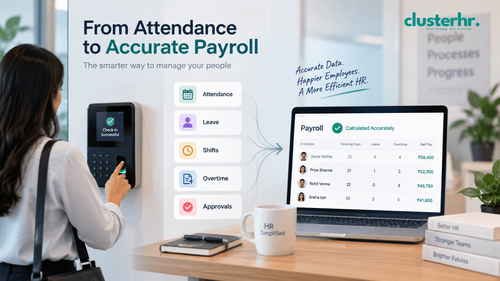
Payroll errors rarely start in the payroll process itself.
A wrong salary calculation can often be traced back to something that happened much earlier. A missed punch, incorrect shift, unapproved leave, wrong overtime entry, or a manual attendance correction can eventually affect an employee's salary.
For growing businesses, this creates a bigger problem. As the number of employees increases, HR teams have more attendance records to manage, more approvals to track, and more payroll inputs to verify.
This is where an employee attendance management system can make a significant difference.
Instead of treating attendance as a separate administrative task, businesses can connect attendance with leave, shifts, overtime, approvals, and payroll. This reduces manual work and gives HR teams more reliable data to work with.
Let's look at how it works.
Why Does Attendance Affect Payroll?
Payroll depends on accurate employee information.
Depending on the organisation's policies, attendance data can influence:
- Working days
- Leave and absence
- Late coming
- Early departures
- Overtime
- Shift allowances
- Loss of pay
- Holidays and weekly offs
- Attendance-based calculations
When this information is collected manually, there are several opportunities for errors.
For example, an employee may forget to punch in. HR may have to verify the attendance manually. The employee may then request regularisation, the manager may need to approve it, and HR may have to update the record before payroll is processed.
Now multiply this process across 100, 500, or 1,000 employees.
Even a small number of incorrect records can create payroll discrepancies.
1. It Creates a Single Source of Attendance Data
One of the biggest problems with manual attendance management is that information can exist in different places.
Attendance may come from a biometric device, spreadsheet, email, WhatsApp message, or HR records. HR then has to combine this information before payroll processing.
An attendance management system brings employee attendance information into one system.
ClusterHR, for example, supports attendance tracking through multiple methods, including biometric, RFID, web check-ins and mobile-based attendance. This gives businesses a centralised way to manage attendance records instead of relying entirely on manual consolidation.
The result is simple:
Better attendance data → better payroll inputs → fewer payroll errors.
2. It Reduces Manual Data Entry
Manual data entry is one of the easiest ways for mistakes to enter an HR process.
An HR executive may accidentally enter the wrong number of working days, miss an attendance correction, or overlook an approved leave request.
When attendance information is captured and maintained digitally, much of this repetitive work can be reduced.
Instead of manually preparing attendance data for every employee, HR can access the records from the system and use them as part of the payroll process.
This is particularly useful for companies where HR teams are already managing recruitment, onboarding, employee records, leave, payroll and other responsibilities.
3. It Helps Manage Missing Punches and Attendance Corrections
Missing punches are common.
An employee may forget to punch in or punch out. There may also be situations where the attendance record needs to be corrected.
Without a proper system, these corrections can become a chain of emails and messages between employees, managers and HR.
An attendance management system can provide a structured process for attendance regularisation and approvals.
This means HR has greater visibility into:
- Missing punches
- Attendance corrections
- Approval status
- Employee attendance history
Instead of making changes based on scattered requests, HR can manage them through a defined workflow.
That creates a cleaner attendance record before payroll is processed.
4. It Connects Attendance With Leave
Leave is another area where attendance and payroll can easily become disconnected.
Imagine an employee has taken approved leave, but the attendance record still shows an absence. If the information is not updated correctly, it could potentially affect salary calculations.
When attendance and leave management are connected, approved leave information can be reflected in the employee's attendance records.
ClusterHR brings attendance and leave management together, helping HR teams maintain a more consistent employee record.
This reduces the need to manually compare attendance reports with separate leave records every month.
5. It Helps Track Shifts More Accurately
Shift-based organisations face another layer of complexity.
Employees may work different shifts, rotating schedules, overtime hours, or different working patterns. Managing these records manually can make attendance processing much harder.
An attendance management system can help HR manage shift schedules and compare actual attendance against assigned shifts.
ClusterHR includes shift management along with attendance tracking, allowing businesses to manage attendance across different employee schedules.
This becomes particularly useful when an organisation has multiple teams, shifts, or locations.
6. It Makes Overtime Tracking Easier
Overtime can directly affect payroll.
If overtime hours are tracked manually, HR may need to collect information from managers, attendance records and spreadsheets before calculating the final amount.
An attendance management system can help capture overtime-related information as part of the overall attendance process.
Instead of treating overtime as a completely separate activity, businesses can manage it alongside employee attendance.
This gives payroll teams better visibility into the hours that may need to be considered during salary processing.
7. It Reduces the Chances of Payroll Disputes
Payroll disputes don't always happen because payroll teams make mistakes.
Sometimes the underlying attendance information is unclear.
An employee may question why their salary was reduced. HR then has to go back through attendance records, leave information, approvals and manual changes to understand what happened.
A centralised attendance system gives HR a clearer record of employee attendance.
When employees and HR can refer to the same attendance information, it becomes easier to identify what happened and resolve questions faster.
This can save HR teams considerable time during payroll periods.
8. It Gives HR Better Visibility Before Payroll Processing
One of the biggest advantages of digital attendance management is visibility.
Instead of discovering attendance problems during payroll processing, HR can identify issues earlier.
For example:
Missing punch → Regularisation → Approval → Updated attendance → Payroll processing
This is much better than:
Payroll processing → Error discovered → HR investigates → Employee complaint → Correction
The earlier an attendance issue is identified, the easier it is to resolve.
9. It Helps HR Scale Without Adding More Manual Work
A process that works for 20 employees may not work for 200.
At a smaller organisation, an HR executive may be able to check attendance records manually. As the workforce grows, the same approach becomes increasingly difficult.
More employees mean:
- More attendance records
- More shifts
- More leave requests
- More corrections
- More approvals
- More payroll inputs
Automation helps HR handle this increased volume without turning every payroll cycle into a manual exercise.
This is one of the reasons an employee attendance management system becomes increasingly valuable as businesses grow.
Attendance Management Is More Than Clocking In and Out
A common misconception is that attendance software is simply a digital replacement for a biometric machine.
It is much more than that.
Recording when an employee enters the workplace is only the first step.
The real value comes from what happens with that information afterward.
Attendance needs to connect with:
Shifts → Leave → Overtime → Approvals → Payroll
When these processes operate separately, HR has to spend more time moving information between systems.
When they work together, businesses can create a more reliable employee data flow.
How ClusterHR Helps
ClusterHR is designed to connect attendance with the wider employee lifecycle rather than treating attendance as an isolated function.
Its attendance management capabilities support biometric, RFID, web and mobile attendance, along with features such as shift management, overtime and absence tracking, leave synchronisation, notifications and reporting.
This gives HR teams a centralised way to manage employee attendance and the information that surrounds it.
More importantly, ClusterHR connects attendance with other HR processes, including leave and payroll.
For growing businesses, this means HR can spend less time correcting attendance data and more time focusing on employees and business priorities.
Final Thoughts
Payroll accuracy starts before payroll processing begins.
If attendance data is incomplete, outdated or manually entered, payroll teams have to work with unreliable information. The result can be salary discrepancies, employee questions, additional HR work and unnecessary delays.
An employee attendance management system helps address this problem by bringing attendance, leave, shifts, overtime and approvals into a more structured process.
The goal isn't simply to record when employees arrive and leave.
It's to make sure the right attendance data reaches payroll at the right time.
And when attendance becomes part of a connected HR system like ClusterHR, businesses can reduce manual work, improve data accuracy and make payroll processing much more dependable.