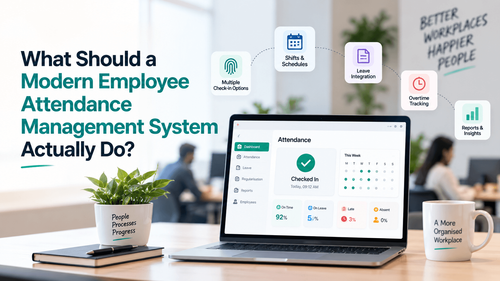
Attendance management sounds simple.
An employee arrives at work, marks attendance, and leaves at the end of the day. On paper, that sounds like the entire process.
But for a growing business, attendance is rarely just about recording when someone enters or leaves the workplace.
HR teams also have to deal with missing punches, late arrivals, early departures, shift changes, overtime, leave, attendance regularisation, remote employees, field teams, multiple locations, approvals and reports.
This is where the difference between attendance tracking and attendance management becomes important.
A modern employee attendance management system should not simply record attendance. It should help HR manage everything that happens around attendance in one structured process.
So, what should a modern attendance management system actually do?
1. It Should Support Multiple Ways to Mark Attendance
Every business has a different workforce.
Some employees work from an office. Some work remotely. Others may travel between client locations or work from different branches.
Because of this, a modern attendance system should not depend on only one method of attendance tracking.
Depending on the organisation's requirements, businesses may need options such as:
- Biometric attendance
- RFID
- Web-based check-ins
- Mobile attendance
- GPS-based attendance
- Geofencing
This gives businesses more flexibility while maintaining a central attendance record.
For example, an office employee may use a biometric device, while a field employee may need mobile-based attendance with location verification.
The objective is simple: employees should be able to record attendance through a method that fits the way they work.
2. It Should Handle Different Work Schedules
Not every employee works from 9 to 5.
Businesses may have:
- General shifts
- Rotational shifts
- Night shifts
- Flexible working hours
- Different schedules for different departments
- Multiple shift locations
Managing these schedules manually can quickly become complicated.
A modern attendance management system should allow HR teams to create and manage different shifts and assign them to employees or teams.
It should also help HR compare scheduled working hours with actual attendance.
This becomes especially important for businesses with large workforces where manually checking individual schedules is no longer practical.
3. It Should Manage Missing Punches
Employees forget to punch in.
They forget to punch out.
It happens.
The problem begins when HR has to manually track every missing punch and follow up with employees.
A good attendance management system should identify missing or incomplete attendance records and provide a structured way to resolve them.
Instead of employees sending individual messages to HR, they can request attendance regularisation through the system.
HR and managers can then review and approve the request.
This turns a messy manual process into a defined workflow.
4. It Should Support Attendance Regularisation
Attendance regularisation is one of those small HR activities that can consume a surprising amount of time.
An employee may have forgotten to punch in. A biometric device may not have recorded a punch. There may have been an approved work-related reason for an unusual attendance record.
Without a structured system, HR may have to manage these cases through emails, messages and spreadsheets.
A modern system should allow employees to raise regularisation requests and managers or HR teams to review them.
This creates a record of:
What happened → Why it happened → Who requested the correction → Who approved it
That improves visibility and reduces unnecessary back-and-forth.
5. It Should Connect Attendance With Leave
Attendance and leave are closely connected.
If an employee is on approved leave, the attendance record should reflect the relevant information.
Without integration, HR may need to compare attendance records with separate leave records every month.
This can create additional work and increase the possibility of inconsistencies.
A modern attendance management system should allow attendance and leave information to work together.
When an employee applies for leave and the request is approved, the relevant information can be reflected within the employee's attendance record.
This gives HR a more complete view of employee availability and attendance.
6. It Should Track Overtime
For many businesses, attendance isn't limited to whether an employee was present.
The number of hours worked can also matter.
Employees may work beyond their scheduled shift, particularly in industries or organisations where overtime is part of the working model.
A modern attendance system should help businesses capture and manage overtime information.
This can include:
- Overtime hours
- Overtime approvals
- Shift-based overtime
- Employee overtime records
- Reports
When overtime information is managed within the attendance system, HR has better visibility into the employee's actual working information.
7. It Should Work Across Locations
Managing attendance becomes more challenging when a company operates from multiple locations.
A business may have offices in different cities, branches, warehouses, factories or other work locations.
Using separate attendance processes for each location can make reporting and administration difficult.
A modern system should allow organisations to manage employees and attendance across different locations from a central platform.
This gives HR a broader view of the workforce while still allowing location-specific rules and schedules where required.
8. It Should Support Remote and Field Employees
The workplace has changed.
Not every employee works from a traditional office every day.
Remote employees, sales teams, service teams and field workers may need different ways to record attendance.
Mobile attendance, GPS-based check-ins and geofencing can help businesses manage attendance for employees who aren't always sitting at an office desk.
The important point is that attendance management should adapt to the workforce rather than forcing every employee into the same attendance process.
9. It Should Give HR Useful Reports
Collecting attendance data is only one part of the process.
HR also needs to understand that data.
A modern attendance management system should provide useful reports that help HR identify patterns and issues.
Reports may cover:
- Employee attendance
- Absences
- Late arrivals
- Early departures
- Overtime
- Missing punches
- Shift attendance
- Attendance regularisation
- Location-based attendance
Instead of manually creating reports from spreadsheets, HR can access information from the system.
This can make it easier to identify recurring attendance issues and understand workforce patterns.
10. It Should Reduce Manual HR Work
This may be the most important requirement.
The purpose of attendance software isn't simply to replace a paper register with a digital screen.
It should reduce the amount of repetitive work HR has to perform.
Think about the number of activities HR may otherwise need to handle manually:
Collect attendance → Check missing punches → Contact employees → Update records → Check leave → Verify shifts → Calculate overtime → Prepare reports
A connected attendance management system can bring many of these activities into one workflow.
That gives HR more time to focus on work that requires actual human judgement.
11. It Should Provide Employee Self-Service
Employees shouldn't need to contact HR for every attendance-related question or request.
A modern system should give employees access to relevant information and actions through an employee self-service interface.
For example, employees may be able to:
- View attendance
- Check attendance history
- Apply for regularisation
- Apply for leave
- Review relevant records
- Access other HR information
This reduces dependency on HR for routine requests.
It also gives employees greater visibility into their own attendance information.
12. It Should Provide Notifications and Alerts
Attendance problems are easier to resolve when they are identified early.
Notifications can help employees and managers stay aware of relevant actions.
For example, the system can help notify users about attendance-related events, requests or approvals.
Instead of HR manually reminding employees and managers about every pending action, automated notifications can support the process.
This is particularly useful when an organisation has hundreds of employees and multiple managers.
13. It Should Connect With Payroll
Attendance should not exist in isolation.
Attendance information can influence payroll through working days, absences, leave, overtime and other company-specific rules.
When attendance and payroll are managed separately, HR may need to transfer information manually from one system to another.
That creates another opportunity for errors.
A connected HR system can allow attendance information to become part of the wider payroll process.
This creates a more connected flow:
Attendance → Leave → Overtime → Approvals → Payroll
The objective is not simply to automate attendance. It is to make the information useful across the employee lifecycle.
14. It Should Scale With the Business
A system that works for 25 employees may not be enough when the company reaches 250 employees.
As businesses grow, they may add:
- More employees
- More departments
- More locations
- More shifts
- More managers
- More attendance methods
The attendance system should be able to handle this growing complexity without forcing HR teams back into manual processes.
Scalability should therefore be considered when choosing an attendance management system.
Attendance Tracking vs Attendance Management
This distinction is worth remembering.
Attendance tracking answers:
Did the employee attend?
Attendance management answers:
What was the employee's schedule, attendance status, leave, overtime, regularisation and approval history, and how does this information fit into the wider HR process?
A biometric device can record a punch.
An attendance management system should help manage everything that happens before and after that punch.
That is the real difference.
What Should Businesses Look for When Choosing Attendance Software?
Before selecting an employee attendance management system, businesses should consider whether it can support their actual workforce.
Some important questions include:
- Does it support multiple attendance methods?
- Can it manage different shifts?
- Can employees request attendance regularisation?
- Can managers approve attendance requests?
- Can it handle multiple locations?
- Does it support remote and field employees?
- Can it track overtime?
- Does it integrate with leave management?
- Does it connect with payroll?
- Can employees access their own attendance information?
- Does it provide useful reports?
- Can the system scale as the workforce grows?
The right choice depends on the organisation's workforce, processes and requirements.
How ClusterHR Helps With Attendance Management
ClusterHR takes attendance beyond simple clock-in and clock-out tracking.
Its attendance management capabilities support biometric, RFID, web check-ins and mobile attendance, helping businesses manage different workforce requirements from one platform.
ClusterHR also supports features such as GPS, geofencing, shift management, overtime and absence tracking, leave synchronisation, notifications and reporting.
This allows businesses to create a more connected attendance process instead of managing different attendance activities separately.
More importantly, attendance can work alongside other HR functions within ClusterHR, including leave management, payroll and employee self-service.
This means businesses can move from simply recording attendance to managing the complete process around it.
Final Thoughts
A modern employee attendance management system should do much more than record when employees enter and leave work.
It should help businesses manage attendance, shifts, missing punches, regularisation, leave, overtime, locations, remote employees, approvals, notifications and reporting in a structured way.
The goal is not to make attendance more complicated.
It is to remove the unnecessary manual work around it.
For growing businesses, this becomes increasingly important. When attendance data is accurate, accessible and connected with other HR processes, HR teams can spend less time chasing records and more time managing people.
ClusterHR brings these attendance capabilities together with the wider HR lifecycle, helping businesses create a more connected and efficient way to manage their workforce.