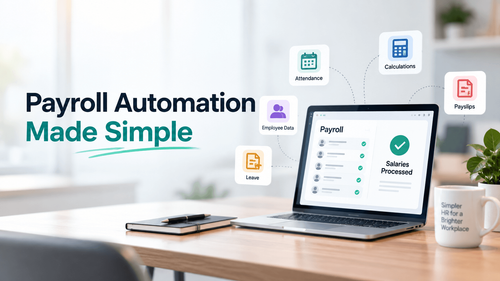
Payroll is one of those HR processes that has to be right every single time.
Employees expect their salaries to be processed accurately and on time. HR teams need to manage attendance, leave, overtime, salary changes, deductions, and compliance. Finance teams need accurate payroll data for their records.
As the number of employees grows, managing all of this manually becomes harder.
This is where payroll automation comes in.
Payroll automation uses software to reduce repetitive manual work involved in calculating and processing employee salaries. Instead of HR teams collecting information from different systems and spreadsheets every month, automated payroll can bring relevant employee data together and use it to support a more structured payroll process.
But what exactly does payroll automation automate? How does it work? And what should businesses automate first?
Let's break it down.
What Is Payroll Automation?
Payroll automation is the use of software to automate repetitive tasks involved in employee payroll processing.
A traditional payroll process may require HR to collect information from attendance records, leave registers, employee databases, spreadsheets, and other sources. The information then needs to be checked, calculated, approved, and processed.
With payroll automation, software can handle many of these repetitive steps based on predefined rules and employee information.
This can include:
- Salary calculations
- Attendance inputs
- Leave adjustments
- Overtime information
- Deductions
- Payroll records
- Payroll reports
- Compliance-related calculations
- Payslip generation
The goal is not to remove HR from the payroll process.
The goal is to reduce unnecessary manual work and make the process more consistent.
Why Does Payroll Become Difficult as a Business Grows?
Payroll can seem simple when a company has a small number of employees.
As the workforce grows, however, the number of variables also increases.
Consider a company with 20 employees. HR may be able to manage several payroll activities using spreadsheets and manual checks.
Now consider a company with 200 employees.
There may be different departments, shifts, salaries, leave balances, overtime records, new employees, exits, salary revisions, deductions, and attendance corrections.
Every additional employee creates another set of data that needs to be managed.
This is why businesses often reach a point where the old payroll process starts taking too much time.
How Does Payroll Automation Work?
Payroll automation generally works by bringing employee information and payroll inputs into a central system.
The process can look something like this:
Employee Data → Attendance & Leave → Payroll Inputs → Salary Calculation → Review & Approval → Payslip
Instead of manually transferring information between different files, the system uses available employee data and predefined payroll rules to support the calculation process.
Let's look at the key areas.
1. Employee Information
Payroll starts with accurate employee information.
Basic details such as employee records, salary structure, deductions, and other relevant information need to be maintained properly.
With a centralised payroll system, HR doesn't have to maintain multiple disconnected files for the same employee.
When employee information changes, the relevant records can be updated within the system.
2. Attendance and Leave
Attendance can have a direct impact on payroll.
Working days, absences, leave, late attendance, and overtime may all need to be considered during payroll processing depending on company policies.
If attendance and payroll are managed separately, HR may have to manually compare records every month.
Payroll automation can connect attendance and leave information with the payroll process.
This helps reduce the need to repeatedly enter or reconcile the same information.
3. Salary Calculations
Salary calculation is one of the most important parts of payroll.
Depending on the employee and company structure, payroll may involve multiple components and adjustments.
Automated payroll software can apply configured salary rules and calculations consistently.
This reduces the amount of repetitive calculation HR teams need to perform manually.
It also gives HR a structured process for reviewing payroll before it is finalised.
4. Overtime and Other Adjustments
For businesses with shift-based or hourly employees, overtime can become another payroll challenge.
HR may need to collect overtime information, verify it and include the approved amount during payroll processing.
When attendance and overtime information are managed through the same system, the payroll team can have better visibility into the relevant data.
This can make the overall payroll process easier to manage.
5. Compliance-Related Payroll Tasks
Payroll also involves statutory requirements.
Businesses need to make sure that applicable deductions and payroll calculations are handled according to the relevant rules.
Automated payroll software can help standardise these calculations based on configured rules and requirements.
However, automation does not mean businesses can ignore compliance updates. Payroll rules and statutory requirements can change, so organisations still need appropriate oversight.
6. Payslip Generation
Once payroll is processed, employees need access to their salary information.
Generating and distributing payslips manually can create additional administrative work for HR.
Payroll software can generate payslips as part of the payroll process and make them available through the system.
This also gives employees easier access to their payroll information.
What Should Businesses Automate First?
Not every payroll activity needs to be automated at once.
For businesses starting their automation journey, it makes sense to focus first on repetitive activities that consume significant HR time.
Start With Attendance and Leave
These are often important payroll inputs.
Connecting attendance and leave with payroll can reduce the need for manual reconciliation.
Automate Salary Calculations
Salary calculations can involve multiple components and rules. Automating repetitive calculations can help HR teams reduce manual effort.
Automate Overtime Inputs
If overtime is applicable to your workforce, connecting approved overtime information with payroll can simplify processing.
Automate Payslips
Generating payslips through the payroll system can save administrative time and give employees easier access to their salary information.
Automate Payroll Reports
Payroll reports help HR and management review salary information and payroll activity. Automated reporting can reduce the need to prepare the same reports manually every month.
What Are the Benefits of Payroll Automation?
The value of payroll automation goes beyond saving a few hours during salary processing.
Less Manual Work
HR teams spend less time copying data between spreadsheets, checking calculations and preparing repetitive payroll information.
Better Data Consistency
When payroll uses information from a central system, there is less dependency on multiple versions of spreadsheets and manually updated records.
Faster Payroll Processing
Automating repetitive activities can help HR teams complete payroll-related tasks more efficiently.
Easier Employee Queries
When payroll and employee information are organised within a central system, HR can more easily review relevant records when employees have questions.
Better Scalability
A payroll process that works for a small team may become difficult to manage as the company grows. Automation helps businesses create a more structured process that can support a larger workforce.
Payroll Automation Is Not Just About Salary
This is where many businesses misunderstand payroll automation.
Payroll doesn't begin when HR calculates salaries.
It begins much earlier.
An employee's attendance, leave, overtime, salary structure, deductions and other information can all contribute to the final payroll outcome.
If these processes are disconnected, HR may still spend considerable time collecting and checking information even after purchasing payroll software.
That's why integrated payroll management software can be more useful than a system that only focuses on salary calculations.
How ClusterHR Helps Automate Payroll
ClusterHR brings payroll into a connected HR environment.
Its payroll capabilities are designed to work alongside other HR processes, including attendance and employee information. This allows businesses to manage important payroll inputs within a connected system instead of relying on multiple disconnected processes.
For growing businesses, this can help simplify salary processing, reduce repetitive administrative work, and create better visibility across HR operations.
ClusterHR also combines payroll with other HR functions such as attendance, leave management, employee self-service, recruitment, onboarding and performance management.
This creates a more connected employee lifecycle.
Instead of managing:
Attendance → Leave → Payroll
as separate activities, businesses can bring these processes together within one HRMS.
Final Thoughts
Payroll automation is not simply about pressing a button and generating salaries.
It is about creating a better process around payroll.
When attendance, leave, overtime, employee information and payroll are connected, HR teams can spend less time collecting and checking data manually.
For growing businesses, this becomes increasingly important.
The right payroll automation approach can help businesses reduce repetitive work, improve data consistency, process payroll more efficiently and give employees better access to their information.
Payroll shouldn't become more complicated just because your business is growing.
With the right system, your payroll process can grow with you.
And that's where an integrated HRMS like ClusterHR can help businesses bring payroll and the wider employee lifecycle together in one connected platform.